Through Great Lakes RENEW, 12 research projects advance water efficiency, contaminant removal, and resource recovery for water-intensive industries
CHICAGO, IL — Current, a Chicago-based nonprofit and anchor of Great Lakes RENEW, the National Science Foundation (NSF) Regional Innovation Engine, is investing $5.4 million in 12 new research and development projects to drive water security and circularity. The expanded portfolio will advance technologies to conserve water, detect and treat contaminants, and recover valuable resources from wastewater, with applications for data centers and other water-intensive industries.
The two-year investment in 17 institutions supports research into water reuse, more water-efficient computing, and technologies that detect and treat contaminants such as PFAS and microplastics. Two projects specifically target water challenges associated with data centers, while five address broader water-quality challenges with potential applications across water-intensive industries. Five focus on recovering valuable materials, including critical minerals, and nutrients from wastewater.
As data centers and other water-intensive industries develop across the United States, communities and industries face growing questions about water demand, wastewater management, and reuse. Through Great Lakes RENEW, Current is investing in research to help answer those questions while connecting researchers with the partners, facilities, and expertise needed to move promising technologies toward real-world application.
“Water is increasingly central to the competitiveness of industries shaping our economy, from agriculture and manufacturing to advanced computing,” said Alaina Harkness, CEO of Current and CEO and Principal Investigator of Great Lakes RENEW. “The Great Lakes region is uniquely positioned to lead, bringing together the research, industry expertise, and water resources needed to address growing industrial demands. Through RENEW, we’re investing in the technologies and partnerships that turn water challenges into economic opportunities while advancing more responsible management of our water and energy resources.”
The investment is part of the NSF Regional Innovation Engines program, which builds regional innovation ecosystems across the United States to address national and societal challenges, accelerate technology development, and drive economic growth and job creation. Through partnerships among research institutions, industry, water utilities, and other stakeholders, Great Lakes RENEW works to advance water security and circularity, strengthen the region’s innovation ecosystem, and accelerate the adoption of solutions with potential for impact across the country and beyond.
“This investment reflects the National Science Foundation’s commitment to advancing national priorities through science and technology,” said Erwin Gianchandani, NSF Assistant Director for Technology, Innovation and Partnerships. “By harnessing super intelligence, advancing critical materials research and developing new ways to recover valuable minerals from wastewater, these projects are turning waste into wealth. They demonstrate how innovation can help us make better use of our water resources, strengthen domestic supply chains and create new economic opportunities for American industry.”
RESEARCH TO SUPPORT RESPONSIBLE DATA CENTER GROWTH
Two projects focus directly on data centers, exploring ways to recycle cooling water and reduce their water and energy demands. Five additional projects address contaminants in water and wastewater, developing tools that could support monitoring, treatment, and reuse across data centers and other water-intensive industries.
Recycling Water from Data Center Cooling Systems
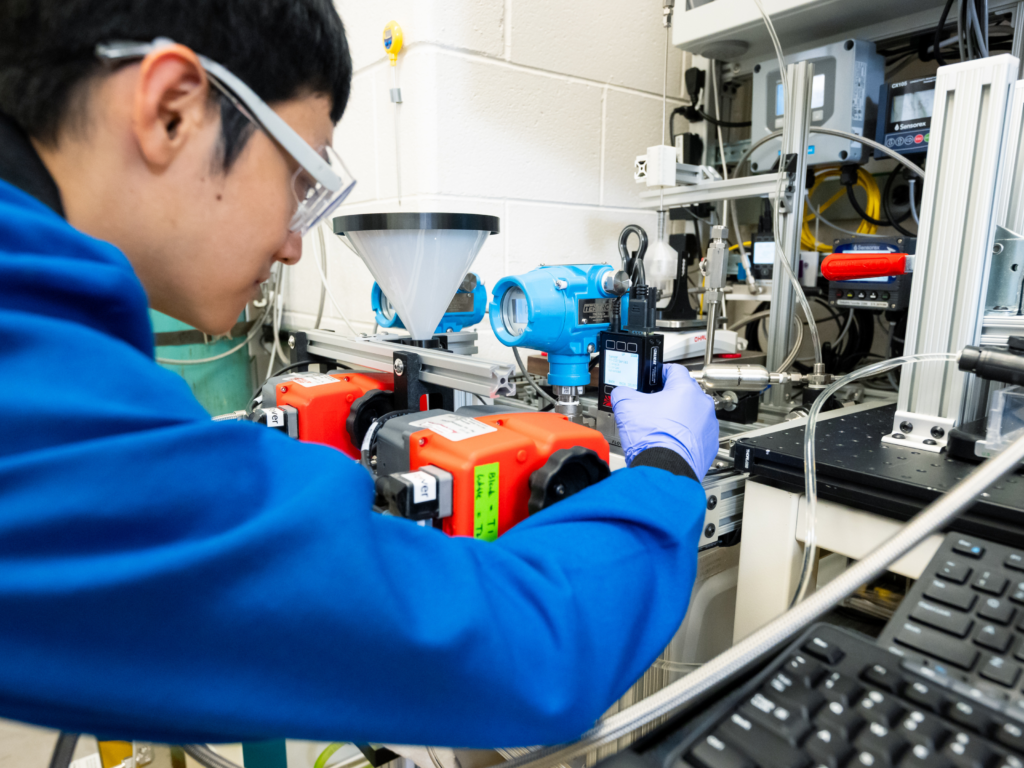
Researchers at The Ohio State University and NONA Technologies, Inc. are piloting a water recycling system that uses electricity to separate dissolved minerals from data center cooling wastewater. This system, which is an on-site pilot at a data center, would allow more water to be reused in on-site cooling systems, reducing data center demand for fresh water.
Reducing Data Centers’ Water Demands
Researchers at the University of Minnesota and Arizona State University are developing a software platform to automatically measure, estimate, and optimize the water and energy needed by data centers to run generative AI services, reducing their demand on freshwater.
DETECTING AND REMOVING CONTAMINANTS FROM WASTEWATER
Effective water-quality monitoring and treatment can help industries manage wastewater and expand opportunities for reuse. The following five projects target PFAS, or ‘forever chemicals’, and microplastics through new approaches to detection, removal, and destruction.
Removing PFAS from Wastewater with Nanofiltration Membranes
Researchers at the University of Wisconsin-Milwaukee and Argonne National Laboratory are developing advanced nanofiltration membranes that selectively remove per- and polyfluoroalkyl substances (PFAS), from contaminated water and wastewater.
Portable PFAS Detection Using AI-Enabled Molecular Probes
Researchers at Argonne National Laboratory and the University of Chicago are developing a portable sensor that uses AI-enabled molecular probes to detect specific PFAS compounds in water at very low concentrations, delivering faster results without requiring specialized laboratory equipment.
Rapid Forever Chemical Detection Using an Inexpensive Handheld Tester
Over the next 18 months, researchers at the Metropolitan Water Reclamation District of Greater Chicago and NanoAffix Science will test a handheld sensor across a range of environmentally relevant wastewater and source water samples to evaluate its potential to detect PFOS faster and more affordably than conventional laboratory methods.
Detecting Microplastics in Wastewater with an AI-Driven Membrane Sensor
Researchers at the University of Minnesota and the University of Wisconsin-Madison are developing an AI-driven membrane sensor to detect and measure microplastics and nanoplastics in wastewater, enabling faster, more continuous monitoring in municipal and industrial wastewater treatment systems.
Testing Technologies to Remove and Destroy Forever Chemicals
Researchers at Argonne National Laboratory and Enspired Solutions are developing a pilot-scale Treatment Train Testbed to rapidly integrate and test technologies for detecting, removing, concentrating, and destroying PFAS across different water streams.
RECOVERING CRITICAL RESOURCES FROM WASTEWATER
Five additional projects aim to recover valuable materials and nutrients from wastewater, creating potential new sources of inputs for advanced manufacturing and agriculture. Recovering critical minerals from wastewater could create new domestic supply chains for batteries, electronics, and other technologies, while nutrient recovery offers opportunities to produce fertilizer ingredients and reduce pollution that contributes to harmful algal blooms.
Lithium from Battery Recycling Wastewater
Researchers at the University of Michigan and Purdue University are developing an electro-intercalation device that uses electricity and specialized materials to harvest lithium from wastewater generated by electric vehicle (EV) battery recycling, while also helping to remove hazardous residual pollutants.
Gallium from Semiconductor Manufacturing Wastewater
Researchers at Argonne National Laboratory and the University of Notre Dame are developing a pilot-scale testbed to selectively separate and recover gallium from semiconductor manufacturing wastewater. The testbed will also serve as a shared platform for RENEW researchers to test recovery technologies for other critical minerals found in a variety of industrial wastewater streams.
Platinum and Other Valuable Metals from Industrial Wastewater
Researchers at the University of Illinois Urbana-Champaign and the University of Michigan are developing an electrochemical separation platform, a technology system that uses electricity, specialized membranes, and advanced sorbent materials to recover and purify platinum group metals (PGMs) from industrial wastewater.
Rare Earth Elements from Mining and Industrial Wastewater
Researchers at the University of Illinois Urbana-Champaign and Northwestern University are developing a regenerable and reusable biomaterial to recover rare earth elements (REEs) from mining and industrial wastewater, reducing the environmental and economic costs of conventional treatment and recovery methods.
Nitrogen and Phosphorus from Municipal Wastewater
Researchers at the University of Illinois Urbana-Champaign and Stanford University are developing an electrochemical process to recover nitrogen and phosphorus from municipal wastewater, turning excess nutrients into fertilizer products while reducing nutrient pollution.
HOW CURRENT SUPPORTS RESEARCHERS FROM LAB TO MARKET
Current leads Great Lakes RENEW, funding teams developing and testing innovative technologies and connecting researchers with industry partners, utilities, and testing facilities to advance solutions toward market adoption. The competitive funding process that informed project selection encouraged collaboration with startups, industry, and end users, resulting in seven projects with industry collaborators, two with utility collaborators, and three led by academic or national laboratory teams.
Across manufacturing, data centers, agriculture, mining, and other sectors, the portfolio connects research to practical industry needs while integrating workforce development and educational opportunities. Students and researchers will gain experience addressing real-world water challenges alongside industry partners and end users.
By pairing research funding with commercialization support and regional partnerships, RENEW helps researchers test, validate, and advance promising technologies toward broader adoption, strengthening the region’s water innovation ecosystem and building pathways from scientific discovery to market impact.
BUILDING A REGIONAL RESEARCH PORTFOLIO
The new awards bring Great Lakes RENEW’s total research and development investment to approximately $12 million across 24 projects, building on NSF’s March 2026 commitment of $45 million in additional support through 2029.
RENEW’s R&D portfolio connects researchers, businesses, national laboratories, and utilities across Illinois, Indiana, Michigan, Minnesota, Ohio, and Wisconsin, with research teams in California and Arizona extending its reach beyond the Great Lakes region. By developing and testing solutions in the Great Lakes, RENEW aims to advance technologies that can be deployed across the United States and globally, strengthening economic competitiveness and national security.
Sustained investment is essential to validate emerging technologies, demonstrate their potential, and scale them for broader adoption. Through Great Lakes RENEW, Current is helping bridge the gap between scientific discovery and real-world application, turning regional research and innovation into solutions with national and global impact.
Learn more about Great Lakes RENEW and its research portfolio.
This material is based upon work on the NSF Great Lakes RENEW Engine supported by the National Science Foundation under Grant No. 2315268.
MEDIA CONTACTS
Beth Heller | beth@mharris.com | 312.953.5879
Haylee Gemeiner | hgemeiner@currentwater.org | 312.448.7740
ABOUT CURRENT
Current is an independent nonprofit founded in Chicago in 2016, with a mission to grow a circular blue economy, accelerate water innovation, and solve pressing water challenges. Current collaborates with industry, innovators, communities, nonprofits, and governments to advance innovative water technologies and policies that boost our economy while protecting our water resources. In 2024, Current was awarded support from the U.S. National Science Foundation to lead Great Lakes RENEW (Recovery of Energy, Nutrients, critical Elements, and Water), one of the inaugural Regional Innovation Engines. Learn more.
ABOUT GREAT LAKES RENEW
Great Lakes RENEW is a National Science Foundation Regional Innovation Engine focused on advancing water security and the circular blue economy. Led by Current, the initiative brings together a coalition of research institutions, national laboratories, utilities, industry partners and community organizations across six Great Lakes states. Through investments in research and development, commercialization and workforce development, RENEW seeks to accelerate solutions that improve water security, recover valuable resources and support regional economic growth.